TECHNOLOGY
Computational Thinking vs Educational Robotics: what's the difference?
By POWAR STEAM
•
August 6, 2026
•
3 min read
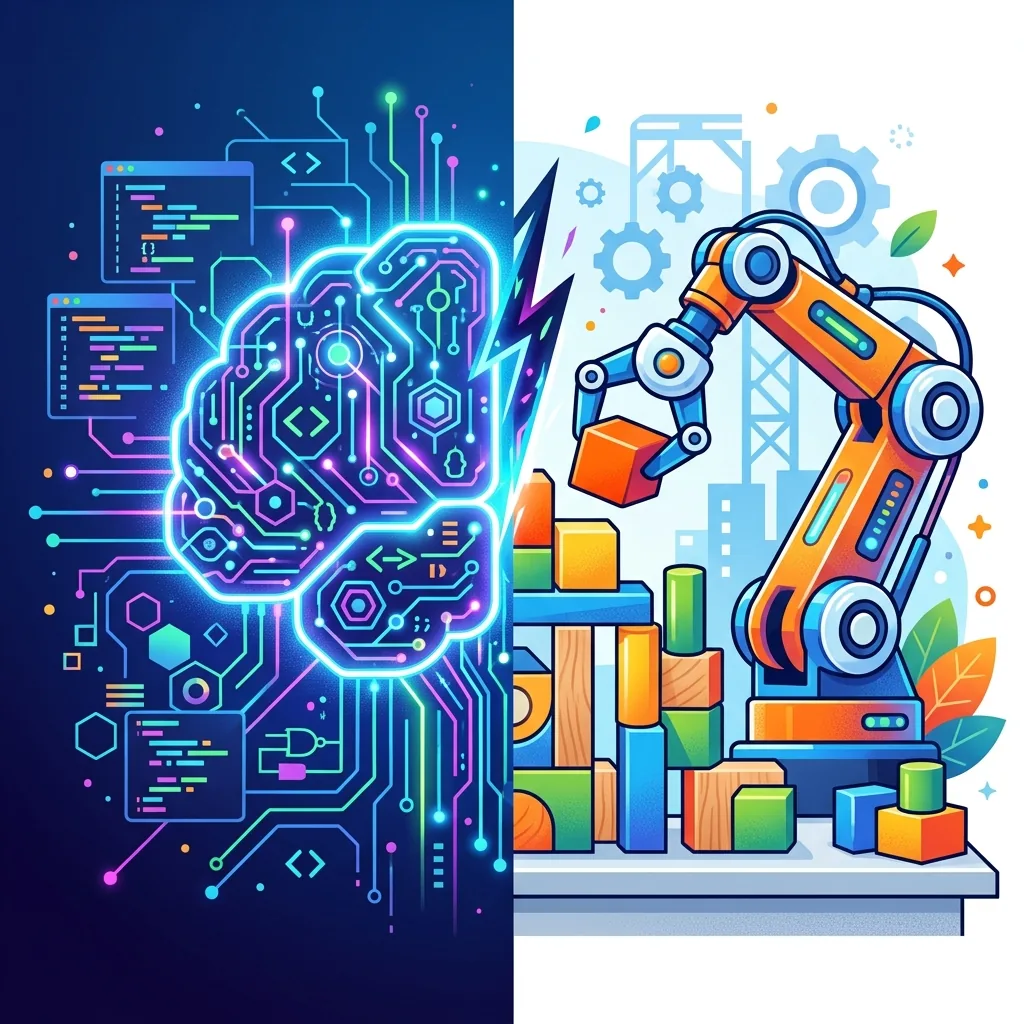
In staff rooms, these two terms often get used as synonyms. They aren't. They're sibling disciplines that need each other, but each one trains a different skill, and mixing them up leads to buying the wrong hardware for the wrong goal.
The term was coined by Jeannette Wing in 2006: it's the ability to formulate a problem and its solution in a way that can be carried out by an information-processing agent, whether that's a computer, a robot or a person.
You don't need a computer to develop it. A screen-free example: organizing a treasure hunt in the playground for 30 students requires decomposing the problem (how many groups, how many clues?), recognizing patterns (which clues repeat in difficulty?), applying abstraction (ignoring the colour of the clue, focusing on its location), and designing an algorithm (the exact sequence of steps each group follows). That's pure computational thinking, without a single wire involved.
Robotics is the physical manifestation: designing, building and programming robots. It adds something computational thinking alone doesn't provide: friction with the real world.
When a student programs a robot to turn 90 degrees, computational thinking dictates the "how" in the code's logic. But robotics has to deal with the fact that the right wheel slipped on the classroom floor and turned 80 degrees instead of 90. That gap between what was programmed and what actually happens is, in itself, a lesson no screen-based exercise teaches quite as well.
A school that wants to work on pure computational thinking can do it with paper, pencil and board games: no purchase needed. A school that wants students to see the physical consequences of their code does need hardware. Confusing the two goals leads to buying expensive robots for a problem a worksheet would have solved, or staying purely theoretical when the real goal was hands-on experimentation.
Separating them completely limits learning. With P-Blocks, students apply computational thinking (logic blocks, conditionals, loops) and see the result on real hardware instantly: a sensor reading, an LED changing colour, a value climbing on a chart. They're not just "thinking like a computer" — they're using that skill to solve a physical, environmental problem in their own surroundings, real friction included.
And this distinction isn't just for the classroom: anyone who organizes, plans or solves everyday problems is already using computational thinking without realizing it. "Building the robot" is just one way to put it to the test, not the only one.
If you want to compare where P-Blocks fits against other block-coding platforms, the article Scratch vs MakeCode vs P-Blocks covers it with concrete examples.
We wrote this article with AI assistance to move faster, and reviewed it by hand before publishing: technical data and links are verified by our team. We're sharing this because it feels like the honest way to do it, not because a law requires it.