TECHNOLOGY
The Best Environmental Sensors for School Science Projects
By POWAR STEAM
•
August 7, 2026
•
4 min read
Measuring is the first move of the scientific method. It's also the easiest thing to ruin with a tangle of wires. We've watched too many science teachers lose fifteen minutes of a fifty-minute class calculating resistors on a breadboard, when the actual goal was getting students outside to collect data.
This is a no-nonsense guide to which sensors are actually worth having in a Primary or Secondary classroom, what each one really measures, and where an all-in-one device wins back class time compared to a classic Arduino build.
You don't need a full catalogue. With these five, most environmental projects in Primary and Secondary have everything they need:
The P-Bit doesn't have a CO2 sensor, and that's a decision, not an oversight. Reliable NDIR CO2 sensors need minutes to warm up before giving a stable reading, cost several times more than the rest of the sensors combined, and in a 50-minute lesson that wait eats up the whole class.
If your project is specifically about ventilation and air quality, you need a dedicated NDIR sensor, not one built into a multipurpose device. The P-Bit is built for what these five sensors measure, which connect directly to most climate-education projects.
The problem with classic hardware isn't sensor quality. Arduino is still excellent and has the biggest community in the world. The problem is time: wiring five sensors on a breadboard, checking every connection, and debugging the first loose wire can eat up half a session before anyone has measured anything.
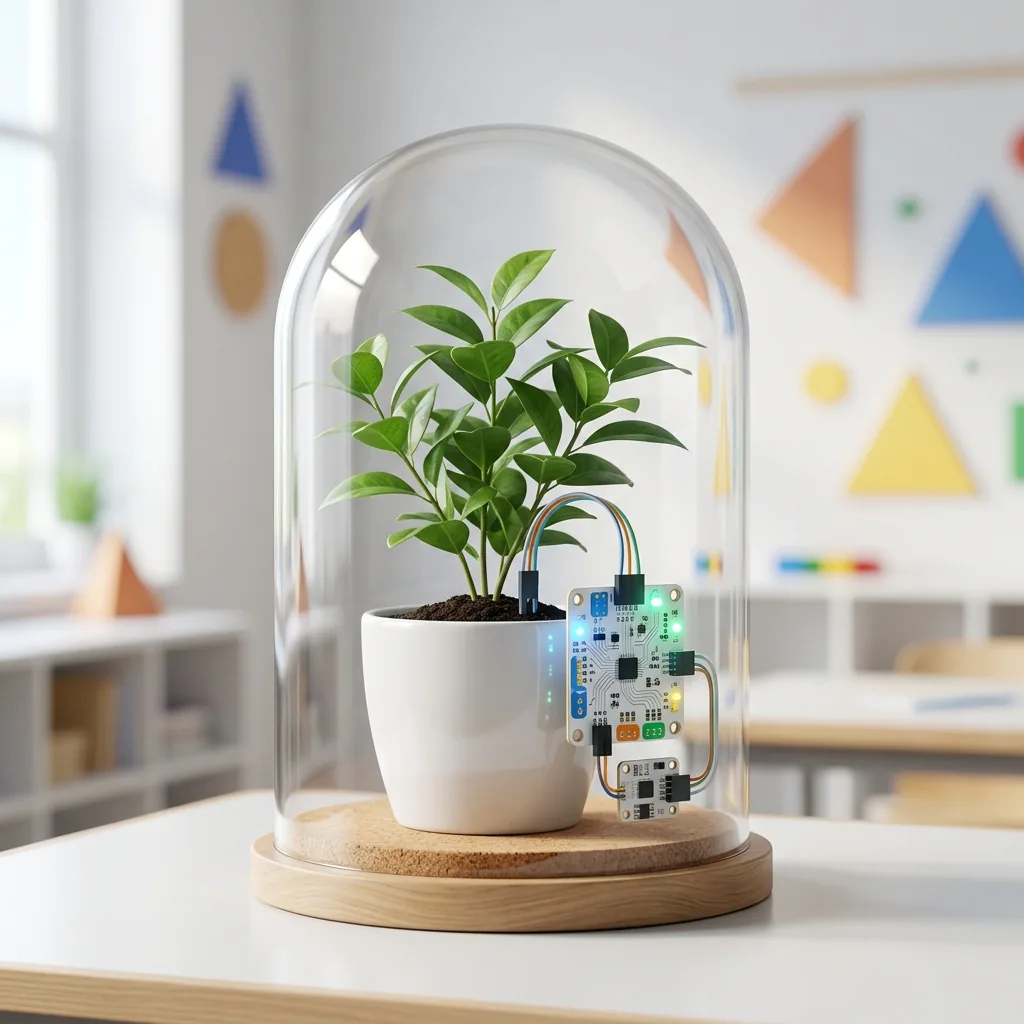
The P-Bit comes with these five sensors, which give six readings because the DHT11 measures both temperature and humidity. There is no breadboard and no loose wires: the two probes plug into their own connectors. And it shows the readings instantly on its screen. The practical difference: a Biology teacher can walk out to the playground and, in under three minutes, have the whole class holding real data — ready to analyse it instead of debugging it. With P-Blocks it can be programmed to react to the data (an LED that changes colour, an alarm) or to send it over Wi-Fi, MQTT or Bluetooth. The Data Dashboard, for projecting it on the classroom's digital board, is in development.
The same five sensors work just as well on a balcony as on a desk. They're showing up more and more in STEAM after-school clubs and summer camps: comparing the humidity of two plant pots, checking whether the bedroom is warmer than the living room, or dunking the DS18B20 probe in a glass of iced water to see how long it takes to melt. You don't need a classroom for the scientific method to work — just curiosity and some free time.
If you want to see these sensors used in a full project, the article on urban heat islands and school microclimates walks through the DS18B20 probe step by step, and the P-Bit technical guide covers how each sensor is calibrated.
We wrote this article with AI assistance to move faster, and reviewed it by hand before publishing: the technical data and links have been verified by our team. We say so because it feels like the honest way to do it, not because a law requires it.