STEAM PROJECTS
Project-Based Learning (PBL): 5 examples for secondary school
By POWAR STEAM
•
August 9, 2026
•
4 min read
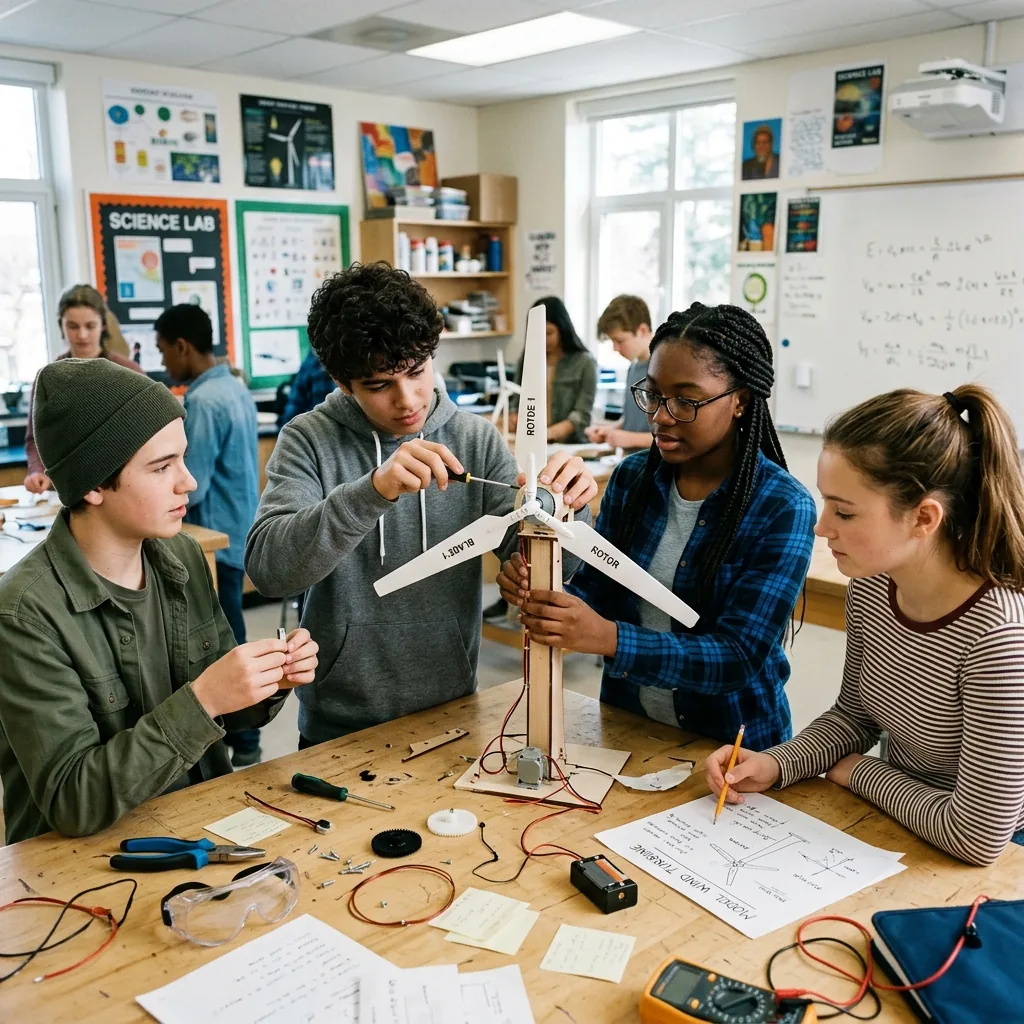
Project-Based Learning isn't "arts and crafts" with a fancier name. It's an evidence-backed methodology that pushes students toward critical thinking, solving real problems, and teamwork on a final product that someone outside the classroom will actually see.
According to the Buck Institute for Education (PBLWorks), an authentic PBL project starts from a driving question that demands investigation and can't be answered by copying a textbook. These five examples are designed for secondary school and integrate technology without requiring more than what a school usually already has.
Driving question: Are we exposed to harmful noise levels in our town?
Each group takes a P-Bit with its microphone to a different spot (school entrance, park, main avenue) and logs sound peaks at the same time every day for a week. With the data exported to a spreadsheet, they calculate averages and identify the zones that exceed the WHO's 65 dB reference for outdoor spaces. The final product is a report with a sound heat map delivered to the town council, with concrete proposals (more green areas, speed limits, loading/unloading schedules).
Driving question: How do we automate plant care at school so they survive the holidays?
Students research the water needs of different crops and calibrate the P-Bit's soil moisture sensor (dry reference, wet reference) before programming, with P-Blocks, a watering system that only activates below a threshold. The real challenge isn't programming the watering — it's deciding what the correct threshold is for each plant, and defending it with data.
These projects fit naturally with the Sustainable Development Goals. The garden connects with SDG 2 (Zero Hunger) and SDG 12 (Responsible Consumption and Production); the sound map, with SDG 11 (Sustainable Cities).
Driving question: How much energy do we waste at school, and how do we prevent it?
With the light and temperature sensors, students compare how much natural light comes in through the windows versus how much artificial lighting is left on, and log whether the heating pushes classroom temperature above what's necessary. The final product is an awareness campaign (video, posters) aimed at the rest of the school, using their own data instead of generic slogans.
Driving question: Can we use technology to self-regulate noise in a study space?
Unlike project 1 (which analyses already-collected data), the goal here is to program a real-time response: with P-Blocks, students build simple conditional logic that turns on a green, yellow or red LED depending on the noise level picked up by the P-Bit's microphone. It's the most direct introduction to conditional (if-then) programming there is with real hardware, and the result gets installed in the school's own library.
Driving question: How do we prevent bike accidents on the way to school?
The "Art" part of STEAM: students design clothing or backpacks with LED strips controlled by a microcontroller, which turn on when a light sensor detects it has gotten dark. It's a project that tends to work as well in robotics clubs and STEAM after-school programs as it does in the classroom, because the final product — something you wear that actually works — is engaging on its own.
If project 4 interests you, the article on classroom noise monitoring walks through the acoustic traffic light step by step, and how to build a Learning Situation with the P-Bit explains how to document any of these five projects for LOMLOE lesson planning.
We wrote this article with AI assistance to move faster, and reviewed it by hand before publishing: technical data and links are verified by our team. We're sharing this because it feels like the honest way to do it, not because a law requires it.